

Budapest to Szentendre by Bike: A Ride Along the Danube
Published Last updated
A scenic and surprisingly peaceful ride through parks, woods and open green spaces beside the Danube, just a short escape from the city.
In this article
The ride at a glance



The story
How it began
We first heard about the cycling route to Szentendre from people who, like us, had moved to Budapest.
A cycle path all the way from Budapest to Szentendre? I had no idea such a route even existed.
Still, I wasn’t particularly tempted. I imagined cycling for kilometres alongside a busy road, with cars rushing past and the constant noise of traffic. Not exactly my idea of a pleasant day out.
But when I mentioned this, they explained that most of the route was actually separated from traffic, following the Danube through parks, woods and green open spaces.
Well, that changed things 🙂
And so, on 1 May 2025, a warm spring day, my partner and I rented two bicycles in Óbuda and set off towards Szentendre.
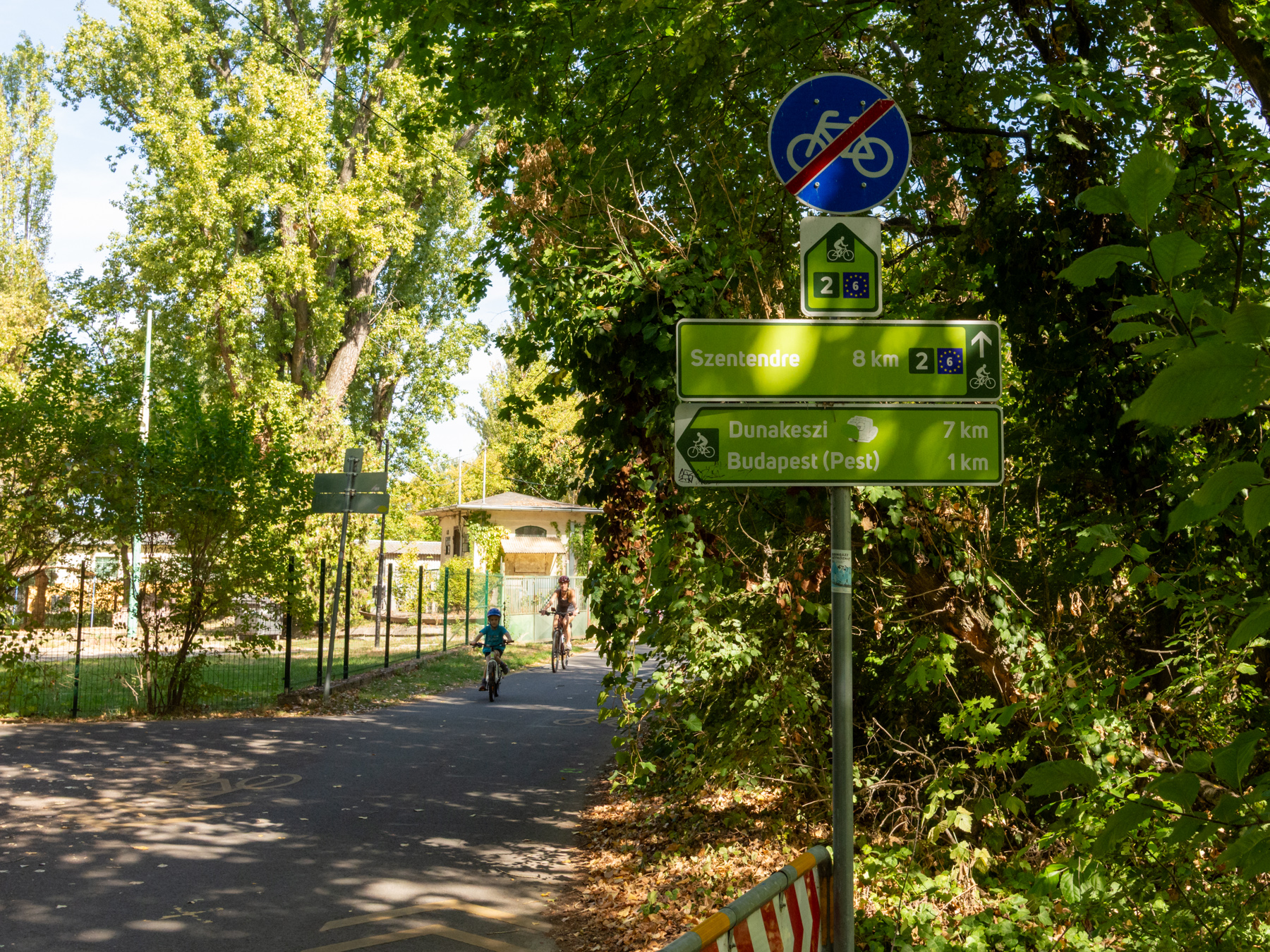
At the time, I knew nothing about EuroVelo 6. We simply followed the signs, occasionally stopping to take photographs or look around.
We enjoyed that first ride so much that we decided to do it again. So on 20 September 2026, we returned to Szentendre — this time knowing that the path we’d followed was part of EuroVelo 6, an international route stretching some 4,700 kilometres from the Atlantic Ocean to the Black Sea. It crosses ten countries and follows several of Europe’s great rivers, including the Loire, Rhine and Danube.
And we’d cycled along part of this enormous route without even knowing it!
It reminded me of the strange blue lights I’d once noticed beneath Árpád Bridge from our balcony. I assumed they were meant for passing boats. But no. They were installed for mayflies, of all things! The insects mistake the illuminated road for the river, and the blue lights help keep them over the water.
I wonder how many more things in Budapest we’ve been looking at without having the slightest idea what they’re actually for.
For our second trip, I saved the map on my phone, although the signs towards Szentendre were generally easy to follow.
Practical details
Setting off from Óbuda

Both our journeys began near Szentlélek tér, where we rented bicycles from Óbudakerékpár on Laktanya utca.
The shop is conveniently located for the route, allowing us to avoid cycling through central Budapest.
The rental costs just 500 HUF per hour for a regular trekking bike, so we paid 3,000 HUF each for our six-hour trip. My partner took care of the paperwork, filling out a form with his ID details and leaving a 10,000 HUF deposit for both bicycles. Locks were provided too, and the man who helped us was friendly and spoke English.
We left shortly after 11 a.m.
The first part of the ride took us through the streets of Óbuda. The surroundings were still familiar — residential buildings, intersections and occasional traffic — but before long, the road brought us towards the Danube.
And then came Római-part.
The riverside
Római-part and the faces in the trees
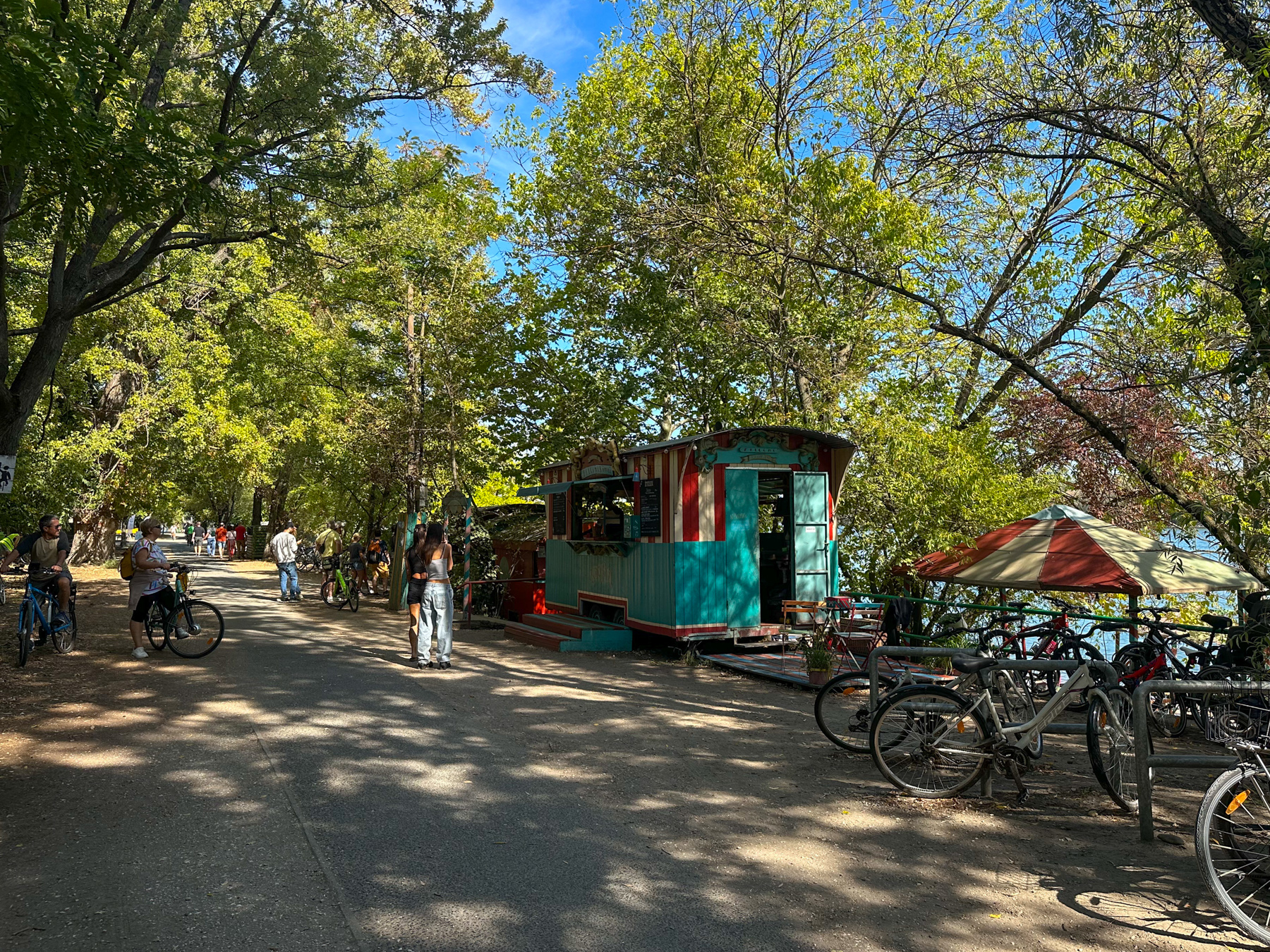
By our second journey, we’d already developed a small tradition.
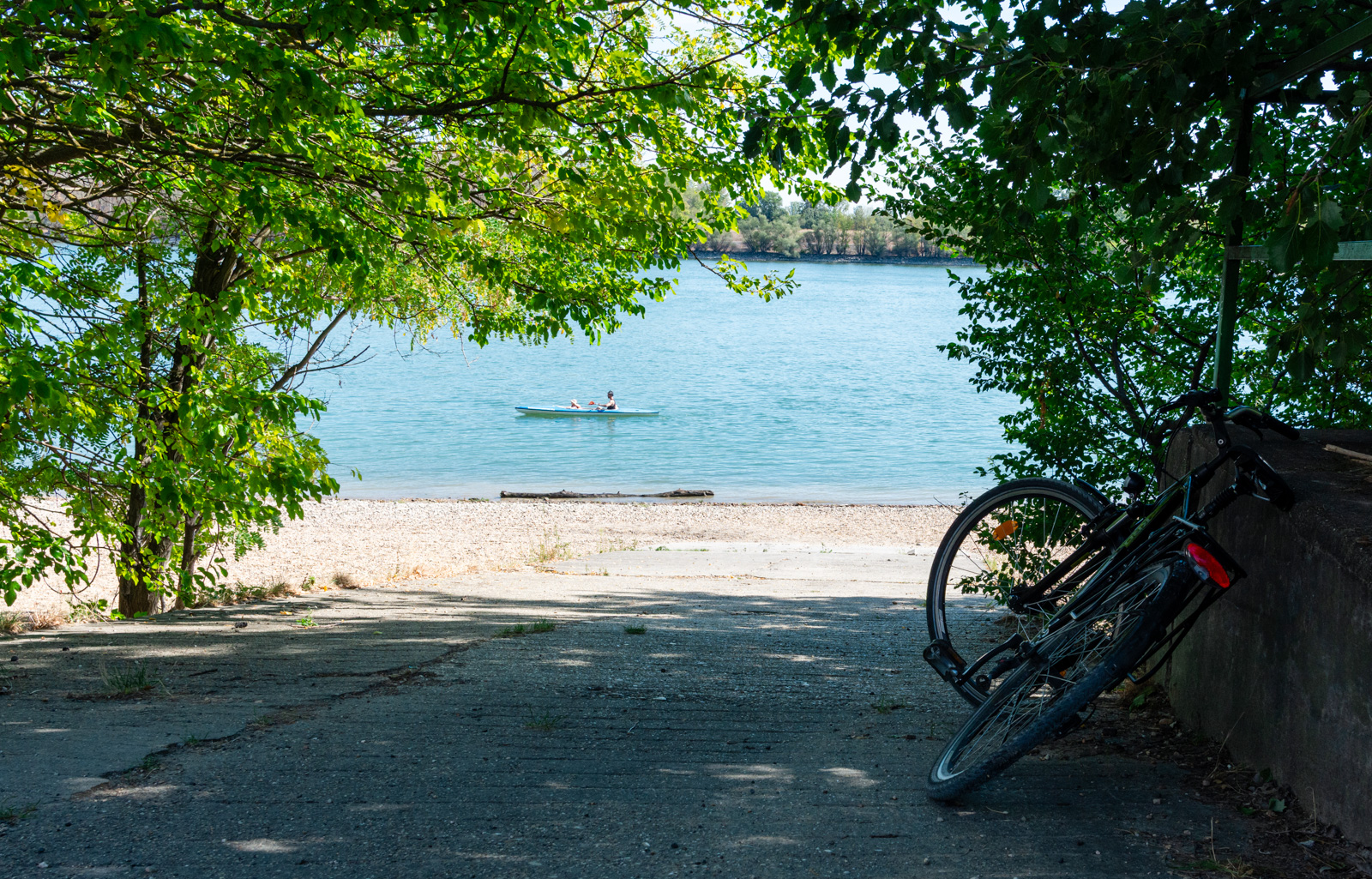
Where the paved path turns to gravel, we stop beside the Danube, park our bicycles and have something cold to drink.
The river flows quietly past, people sit along the shore, and the shade of the trees offers a welcome break from the sun.
Farther along, things become considerably livelier.
Római-part is full of open-air cafés, food stalls and restaurant terraces. On a warm day, people are everywhere — sitting by the river, chatting over drinks, walking with children or making their way between the tables.
For cyclists, this is probably the least enjoyable part of the journey.
The surface is uneven and gravelly in places, and getting around pedestrians can be quite troublesome. Sometimes it’s easier to get off the bicycle and walk until the path becomes less crowded.
Fortunately, the busiest section doesn’t last very long.
There is, however, something worth looking for among the trees.

Strange faces appear on the trunks. Some have large noses and deep-set eyes; others resemble little forest spirits, their features formed from mud and decorated with pieces of bark, leaves and twigs.
Hungarian land-art artist Tamás Kánya creates such sculptures along the Danube, using materials he finds nearby.
The works aren’t made to last. Rain washes away the mud, wind scatters the leaves, and little by little, nature takes back what was borrowed from it.
Perhaps that’s part of what makes them so interesting. A face found on one visit may have disappeared by the next.
Beyond the busy cafés, the riverside gradually becomes quieter.
A quieter stretch
Along Kossuth Lajos üdülőpart
The route continues beside the Danube along Kossuth Lajos üdülőpart, past trees, lawns and the green surroundings of Pünkösdfürdő Park.
Opened in 2022, the park covers around seven hectares and stretches along approximately 1.5 kilometres of riverbank.
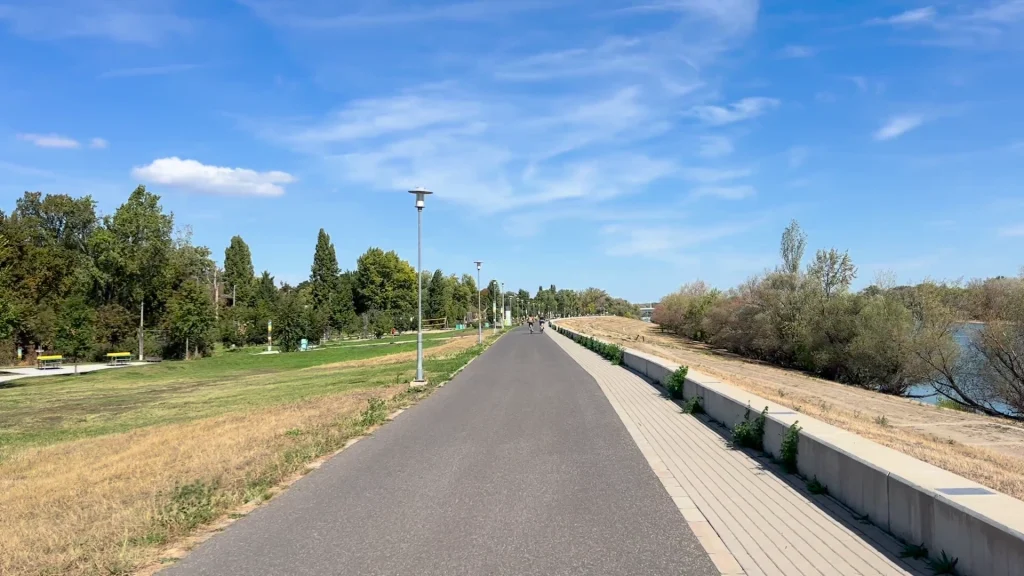
Much of the landscaping was designed to resemble natural meadows, with wildflowers, grasses, shrubs and trees. It’s a pleasant change from the crowds of Római-part, and there are plenty of places to sit or take a short walk.
We continued cycling.
Soon, the path entered a wooded area.
What surprised me most was that the bicycle path remained properly asphalted, even among the trees.
Every now and then, another cyclist passed us. Birds were singing in the trees, and sunlight kept breaking through the leaves, shining straight into our eyes before we rode back into the shade. Then came the sunshine again, and then the shade.
Something about it reminded me of the first days of summer holidays as a child, when even an ordinary day felt like the beginning of an adventure.
After the gravel and crowds, it was wonderful to ride along such a quiet, smooth path.
The forest eventually began to thin, and the landscape opened up.
Open skies
The open fields near Lupa
This is my favourite part of the journey.
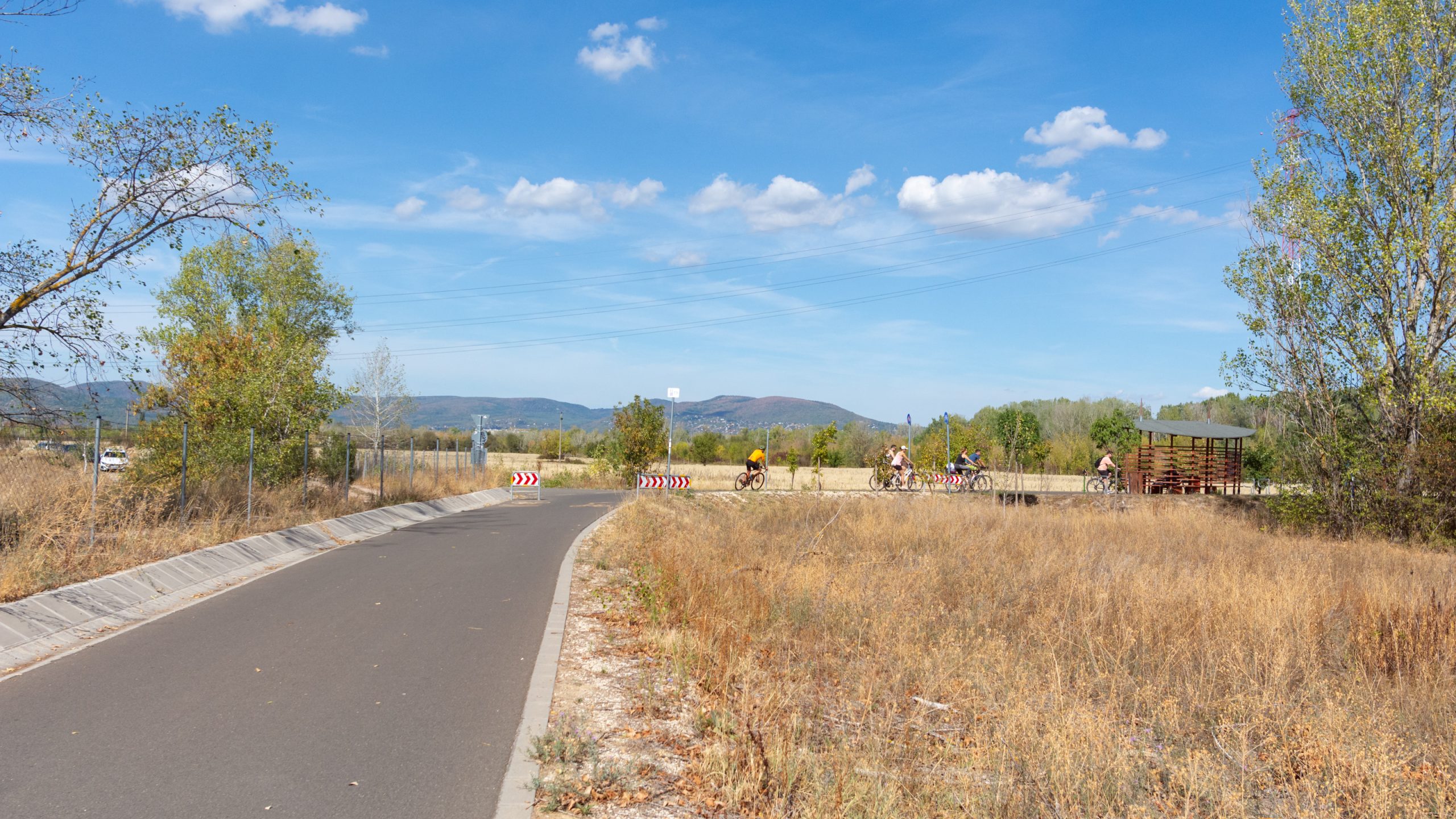
Fields stretch out on both sides, with blue hills on the horizon. And right through the middle of it all runs a smooth, asphalted cycle path.
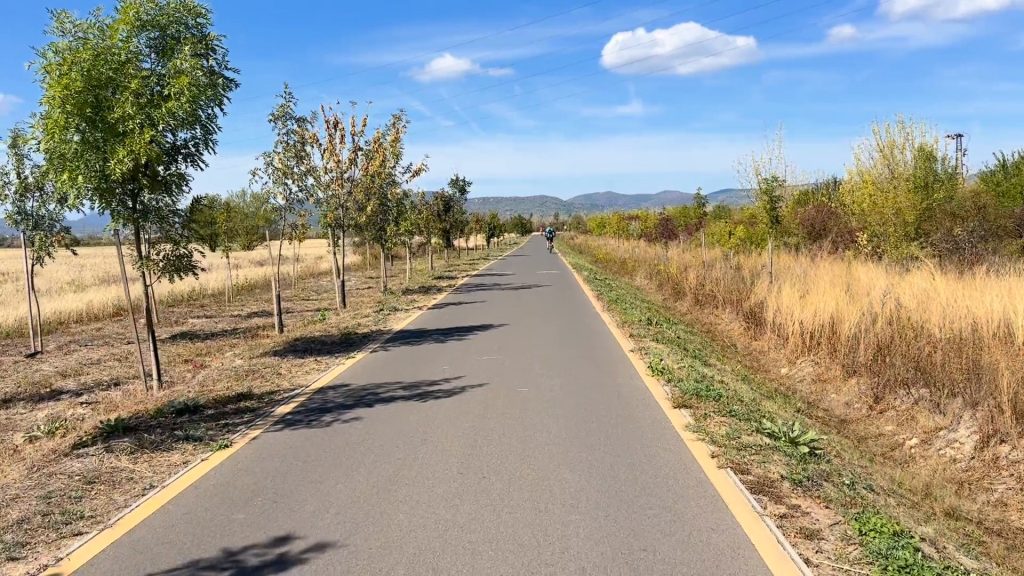
During our first trip in May, we passed haystacks standing in the fields. The crickets were chirping so loudly that it sounded as though summer had already arrived.
The air smelled of fresh grass, and the sun shone brightly across the open land.
By September, the same fields had begun to lose their summer colours. The grasses were drier, and the countryside looked noticeably different.
There is almost no shade along this stretch. On a warm day, the sun can be quite strong, particularly around midday.
It’s worth bringing sunglasses, sunscreen and plenty of drinking water.
But the open countryside is beautiful, and with so few interruptions, cycling here is especially enjoyable. There are long stretches where the road continues straight ahead, with nothing but fields and distant hills on either side.
As we approached Szentendre, the surroundings gradually became more built up.
Before heading into the old town, we made one more stop.
The ride continues
Postás Strand — a beach beside the Danube
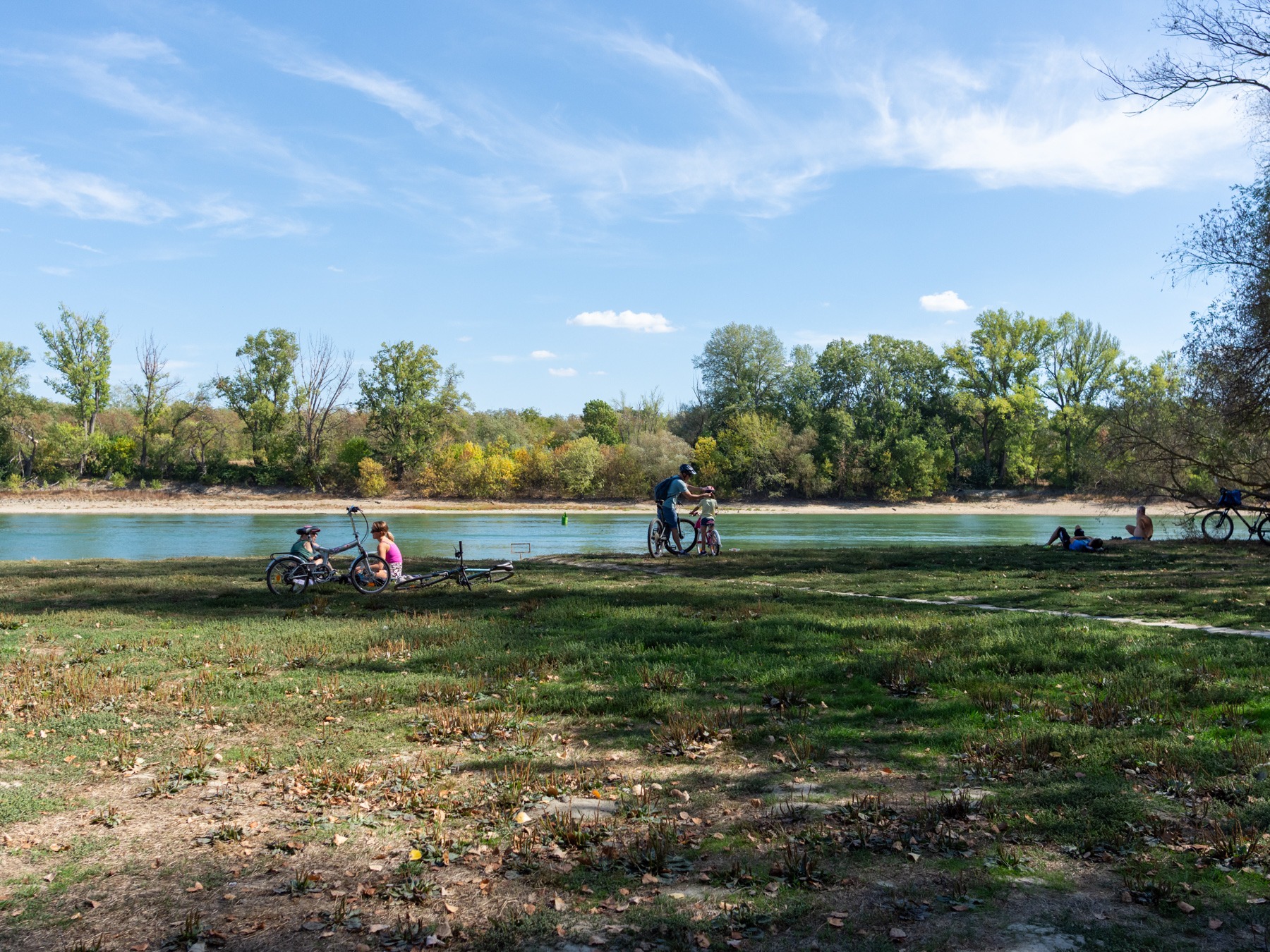
Near the entrance to Szentendre, we found Postás Strand, a small public beach beside the river.
There was a sandy shore, a grassy area and trees offering a little shade. After spending so much of the day in the sun, it seemed like a good place to stop.
My partner was especially pleased to find somewhere to cool off in the water. There was even a shower nearby.
The Danube gets deep quite quickly here, and the current can be stronger than it looks from the shore.
Later, while reading about the beach, I came across an unusual little piece of its history.
In 1923, the Szentendre town council recorded an agreement to lease part of the riverbank to the postal authorities for a bathing area.
The annual rent was calculated according to the market value of 1.2 tonnes of wheat.
The agreement was supposed to run for thirty years, beginning in January 1924.
Today, Postás Strand is a free public beach, with showers, changing facilities and a separate dog-friendly section.
It’s also a convenient stop for cyclists, lying close to the EuroVelo 6 route. The official bathing season runs during the summer, but the riverside can be enjoyed outside that period too.
After our break, we returned to our bicycles and continued towards the centre of Szentendre.
The destination
An afternoon in Szentendre
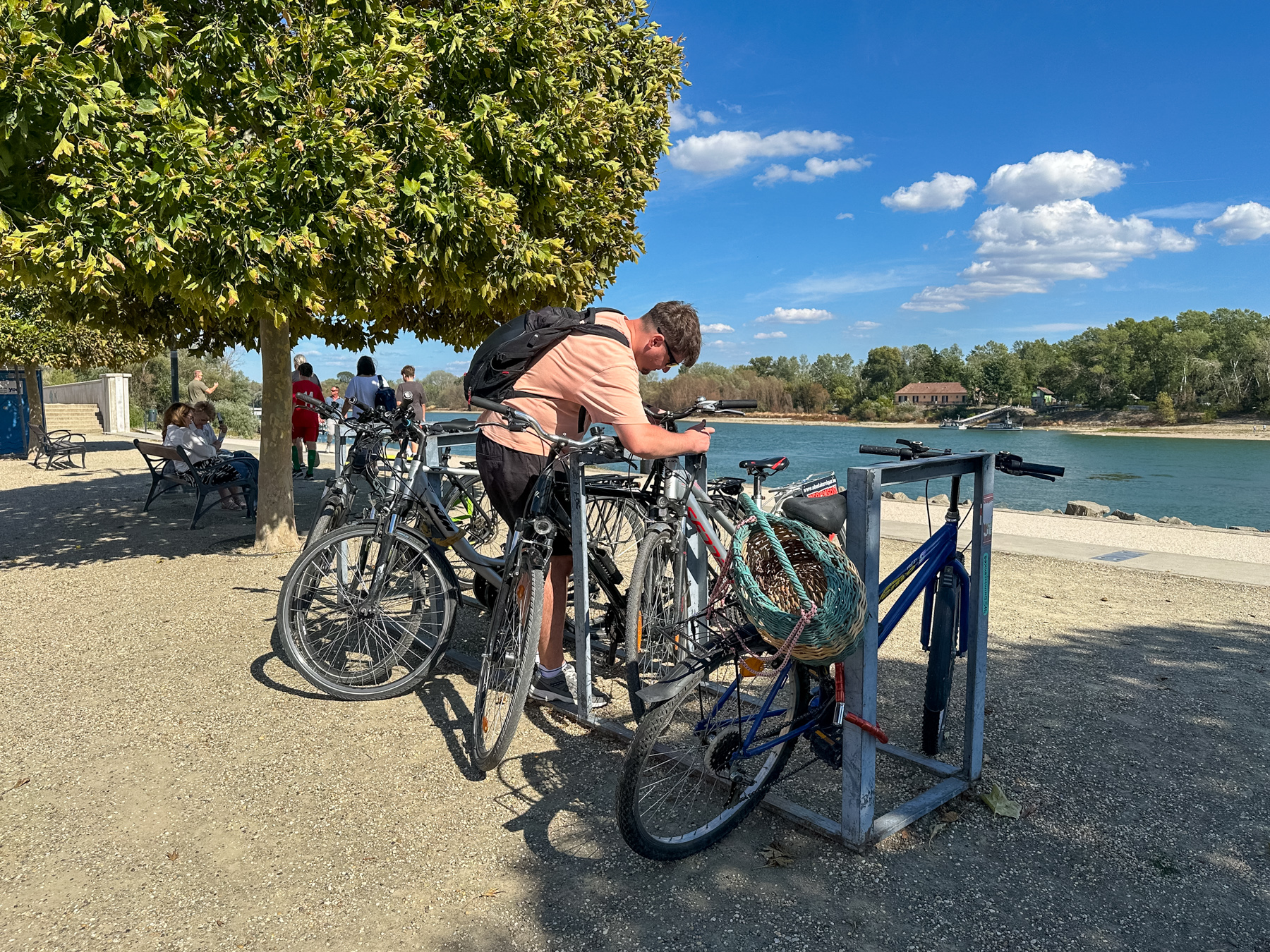
We found a place to lock the bicycles and continued on foot.
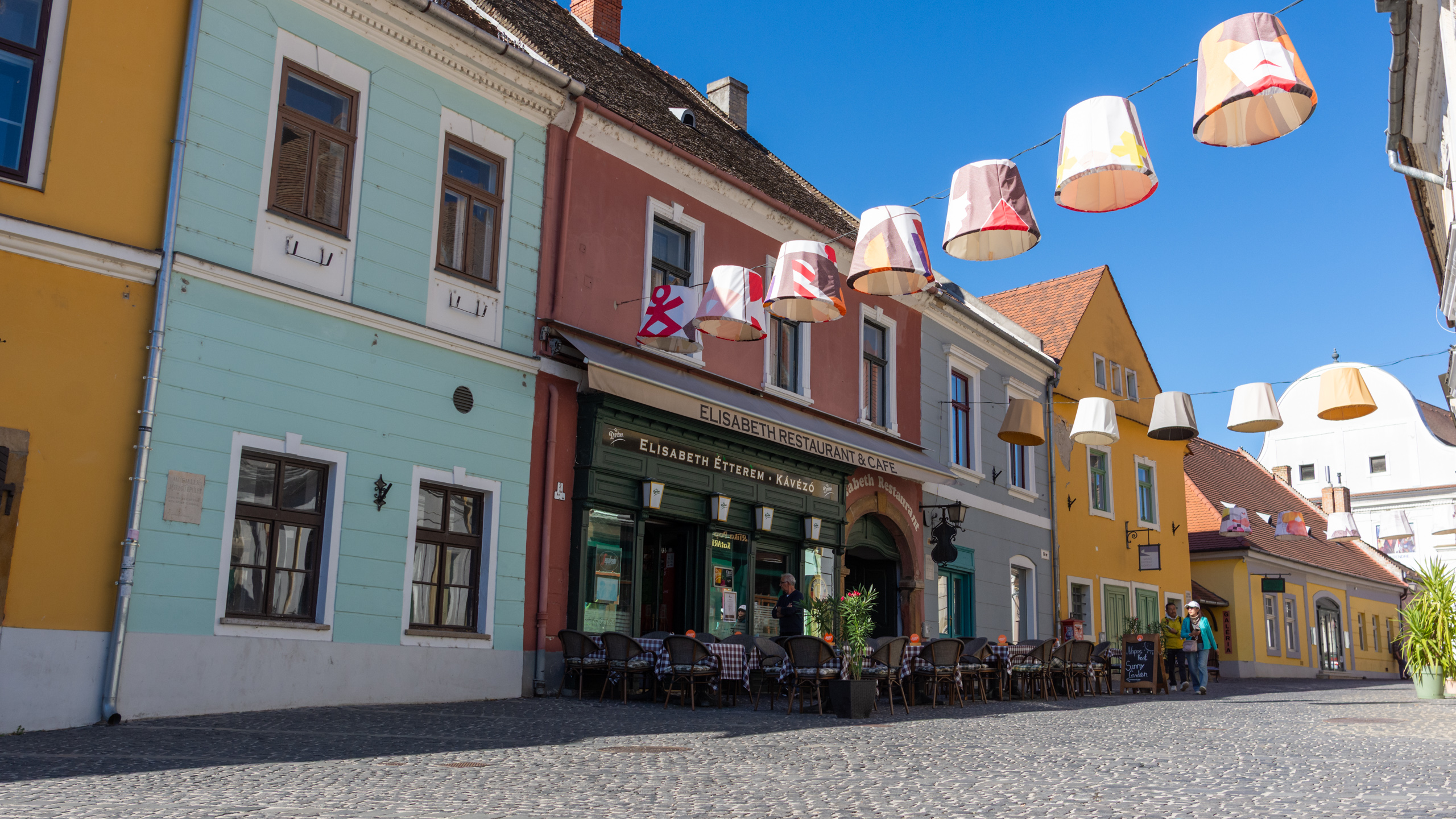
Szentendre has always reminded me a little of a seaside town.
Perhaps it’s the warm colours of the houses, the narrow cobbled streets, the little squares with outdoor cafés, or the way church towers appear between the rooftops.
There’s no sea, of course, only the Danube.
The old centre is full of small galleries, artists’ workshops and shops selling ceramics, paintings and handmade objects. Szentendre has a long artistic tradition, and its architecture also reflects the influence of the Serbian communities that settled here centuries ago.
Wandering through the streets, it’s easy to see why the town attracts so many visitors.
Colourful façades stand beside old churches, narrow passages lead into small courtyards, and café tables occupy almost every available corner.
There’s far more to Szentendre than could fit into the story of a bicycle ride. I’ve devoted a separate article to the hidden stories behind its old streets.
Meanwhile, after a walk around town, we were getting hungry and decided to stop for lángos, the Hungarian fried flatbread usually served with sour cream and grated cheese.


It’s astonishing how popular it is. Hungarians seem to love it, and tourists are apparently just as enthusiastic.
We ate ours and came to a rather definite conclusion: we probably wouldn’t be eating lángos again any time soon 🙂
A coffee in one of the little cafés would have been equally welcome.
Szentendre is the sort of town where it’s pleasant simply to walk around without a particular destination, occasionally stopping to look into a gallery or sit outside and watch people pass by.
There is much more to see than we managed in one afternoon, and the museums and quieter streets deserve a separate visit.
But this wasn’t really a journey about exploring every corner of Szentendre.
We still had seventeen kilometres to cycle home.
The journey back
The ride back to Budapest
| Departure | 15:54 (from Szentendre) |
| Arrival | 17:17 (back in Óbuda) |
| Distance — whole ride | Approximately 34 km |
| Return duration | 1 hr 23 min |
| Notes | Fewer stops on the way back. |
At 3:54 p.m., we collected our bicycles and started back towards Óbuda.
The return journey was considerably faster.
We knew the road by now, stopped less often and made it back to the rental shop at 5:17 p.m.
In total, we’d cycled approximately 34 kilometres.
I hadn’t cycled much since childhood, so I wasn’t quite sure what to expect.
The distance turned out to be manageable, even if my legs had a different opinion by the end of the day.
I was tired, of course. But it was the pleasant kind of tiredness, accompanied by a quiet sense of satisfaction.
We’d spent most of the day outdoors, cycling beside the Danube, through woods and open fields, stopping whenever something caught our attention.
And somehow, by the time we returned our bicycles, it felt as though we’d travelled much farther than seventeen kilometres from Budapest.
Practical information
Before you set off
Starting point and bicycle rental
We rented our bicycles from Óbudakerékpár / Berguson at Laktanya utca 1/B, Budapest, near Szentlélek tér.
During our visit on 20 September 2026, we paid 3,000 HUF per person for approximately six hours, at a rate of 500 HUF per hour. A refundable deposit of 10,000 HUF was required for both bicycles, along with a form containing ID details. Bicycle locks were included.
Distance and cycling time
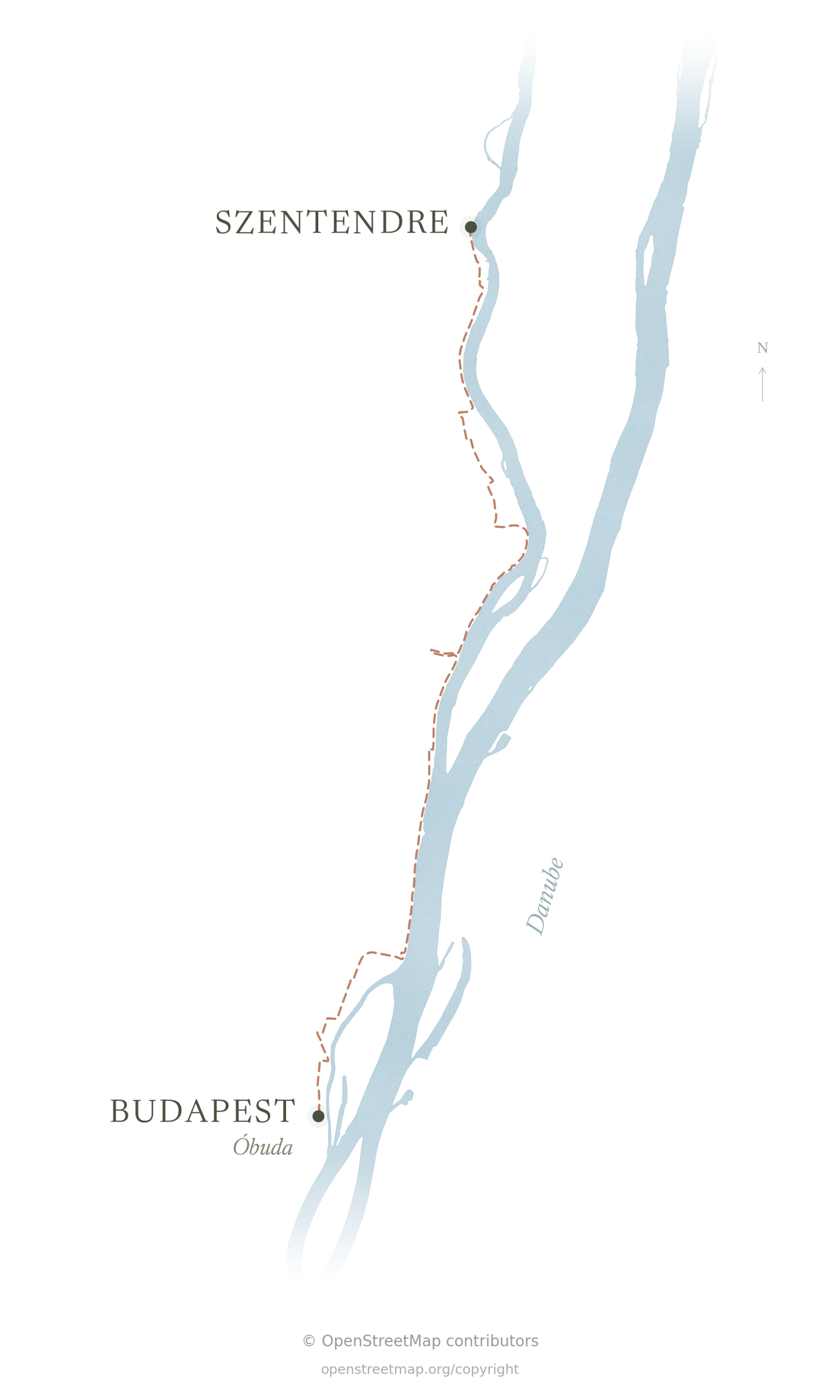
Our journey was approximately 17 km each way, or 34 km in total.
| To Szentendre | Back to Budapest | |
|---|---|---|
| Departure | 11:11 | 15:54 |
| Arrival | 13:04 | 17:17 |
| Duration | 1 hr 53 min | 1 hr 23 min |
| Average speed | 8.9 km/h | 12.5 km/h |
We spent about two hours and fifty minutes between arriving in Szentendre and starting the return journey, including our time at the beach.
Is the route suitable for beginners?
The route is mostly flat, with long sections of dedicated cycling paths separated from motor traffic.
The most troublesome part is Római-part, where there are pedestrians, gravel and occasional crowds.
For someone comfortable on a bicycle and in reasonable physical condition, the journey is quite manageable, although the return trip may feel tiring without much recent cycling experience.
Navigation
Much of the journey follows EuroVelo 6, the Atlantic–Black Sea cycling route.
The road towards Szentendre is generally well signposted, but having a map saved on your phone is useful.
For a mapped Budapest–Szentendre route and a downloadable GPX track, see the funiQ cycling route guide (in Hungarian). Its route starts near Margaret Bridge and is 22 km long; our ride began farther north in Óbuda and was about 17 km each way.
What to bring
Water, sunglasses and sunscreen are especially useful on the open stretches near Lupa.
If you’re planning to explore Szentendre on foot, make sure your rental bicycle comes with a lock.
The best time to go
Spring and early autumn are especially pleasant for this ride.
In May, the fields are green, the trees are full of fresh leaves, and the air is warm without the intense heat of midsummer.
September brings drier grasses, softer light and the first signs of autumn.